
A Secure, Cloud-Hosted Way to Run OpenClaw Without Burning Trust
The risky part of running OpenClaw in the cloud is not the install. It is the security exposure and token burn that start growing once it works.
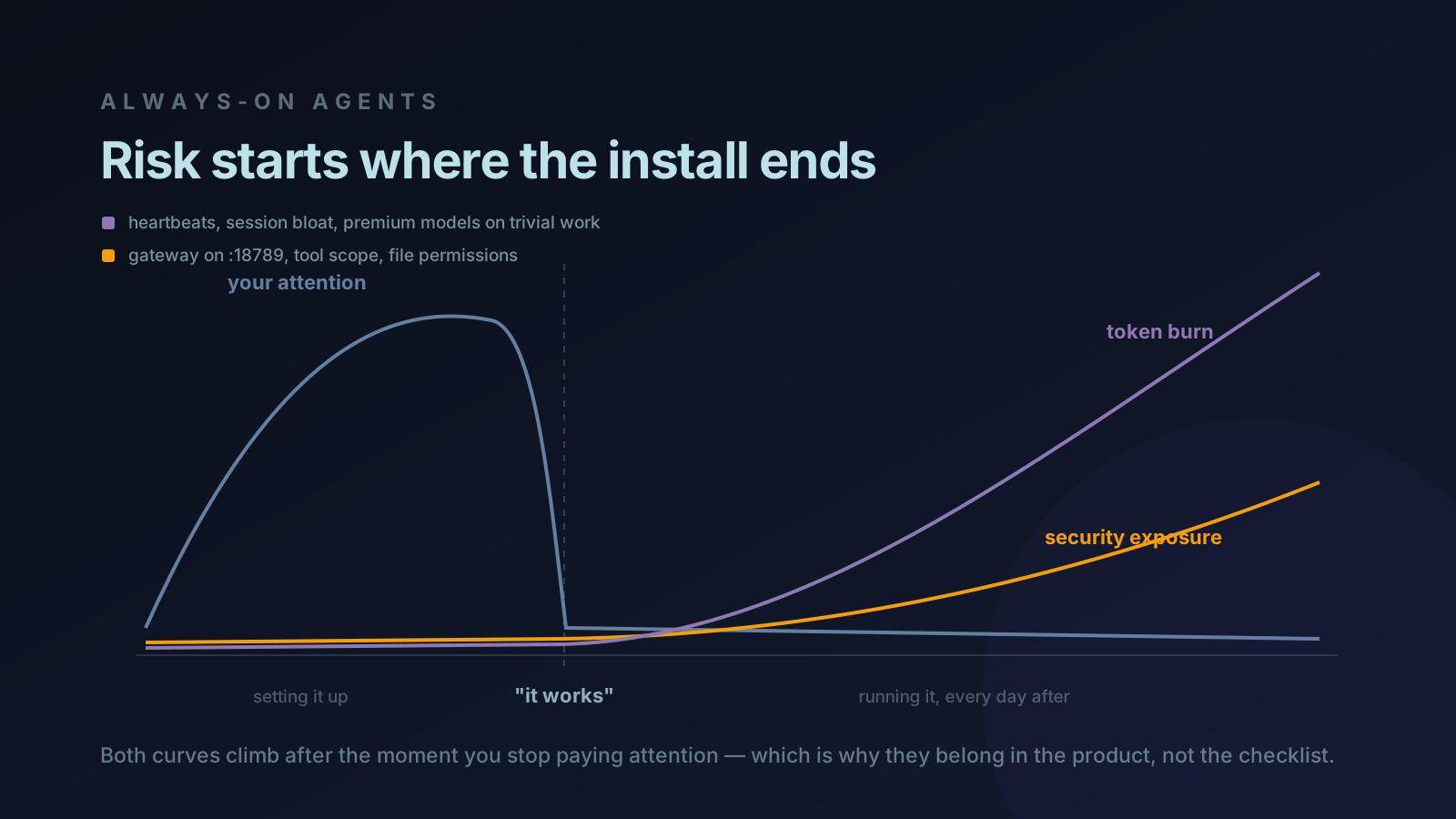
The risky part of running OpenClaw is not the install. It is everything that happens after the install works, when your attention moves on and the agent keeps running.
OpenClaw is compelling precisely because it is not just a chatbot. It runs continuously, connects to the messaging apps you already use, and takes real actions — reading files, running commands, calling external tools. That is also exactly what makes it a security conversation the moment it leaves your laptop.
Why is running OpenClaw in the cloud a security question?
Because a system that can act on your behalf can also leak secrets, be manipulated through prompt injection, or become a foothold if it is exposed to the internet incorrectly. Those are not exotic scenarios; they are the default failure modes of always-on agents with tool access.
The mechanics matter here. The OpenClaw Gateway multiplexes WebSocket and HTTP traffic on a single port — 18789 by default — which is convenient to run and easy to expose by accident. The project's own security documentation is direct about this, and about the baselines that prevent it: bind to loopback, require explicit authentication, pair devices rather than trusting the network, and lock down file permissions.
What makes a safe VPS install harder than the demos suggest?
The demos show the agent working. They do not show the dozen decisions between a fresh server and an agent you would trust with your accounts. You are provisioning a host, installing runtimes and dependencies, keeping a background service alive across restarts, restricting ports, managing SSH access, and deciding what the agent is permitted to execute.
Every one of those is individually reasonable. Together they mean the safe path is the long path — and the long path is the one people abandon halfway.
What goes wrong after the install finally succeeds?
Two things start growing at exactly the moment you stop watching, which is the pattern worth internalising:
- Security exposure. A gateway bound too broadly, a tool scope left wide, file permissions never tightened. None of these produce an error. The system works perfectly while being wrong.
- Token burn. Heartbeats polling around the clock, session histories growing until every request carries a bloated context, and premium models handling trivial background work.
Neither shows up as a failure. One shows up as a bill; the other shows up as an incident, eventually.
The install is where you pay attention. The months afterwards are where the cost and the risk actually accumulate.
What does a hardened deployment actually require?
The same baselines the OpenClaw documentation already recommends — loopback binds, explicit auth, pairing by default, restrictive file permissions — applied consistently rather than remembered. OpenAssist is built around those principles rather than working against them, with each instance running on its own isolated droplet.
The difference is who does the remembering. Authentication is managed, execution scopes are constrained, and sensitive configuration stays inside a protected runtime, so the secure configuration is the one you get by default instead of the one you get by being thorough at 2am.
You should not have to become a part-time security engineer to avoid exposing an agent gateway incorrectly. If the safe path is not also the easy path, most deployments will not take it.
How do you stop tokens leaking by default?
By treating budgets and routing as part of the setup rather than something you tune after the first surprising invoice. The community has already mapped where the spend actually goes, and it is consistent: heartbeat frequency, oversized session histories, and always-on high-cost models doing low-cost work.
So OpenAssist ships with those decisions already made — sane heartbeat intervals, session history that does not grow without bound, and sub-agent tiers so background work routes to cheaper models instead of a premium reasoning model by default. You can still see and change all of it; you just do not have to discover it the expensive way.
This is the same argument as assigning intelligence proportionally, applied at deploy time rather than left as an optimisation exercise.
What does multi-agent orchestration add?
It turns one assistant into a team with a visible board. Rather than a single agent working through requests serially, work is created as tasks, delegated to sub-agents, tracked through states, and attributed back to whichever agent and model handled it.
The pattern is not ours. Bhanu Teja P's Mission Control work showed what a coordinated team of agents looks like in practice; OpenAssist's contribution is making that pattern available without rebuilding the surrounding platform yourself. If you want the mechanics, they are in the Mission Control guide.
Who is this actually for?
People who have decided agents are useful and now want a setup they can trust — technically, financially and operationally. That trust breaks in three predictable places, and the goal is to make the right path the easy one in each:
- You should not need security expertise to avoid exposing a gateway incorrectly.
- You should not learn after the fact that background cycles, context bloat or misrouted models were eating your budget.
- You should not have to build an internal platform to run a team of agents repeatably.
Deploying a powerful always-on agent is deceptively complex, and the cost and security risks rise after you succeed at installing it. The fix is to treat deployment, hardening and cost control as part of the product rather than chores handed to the user — because whichever one you leave to the user is the one that does not get done.
A hardened OpenClaw instance, ready to use
Isolated droplet, managed authentication, constrained tool scopes and token budgets configured before your first agent runs.
Launch your agentKeep reading